
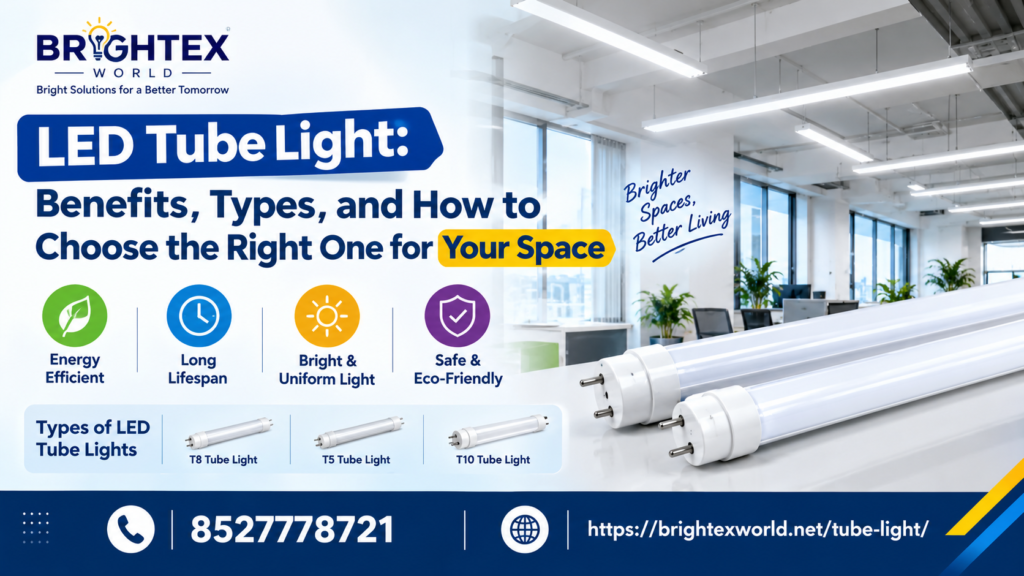
Walk into almost any office, shop, school or workshop and you’ll probably see long, slim tube lights overhead. For decades these were fluorescent tubes. Today, the LED tube light has become a popular replacement and a common choice for new installations in homes, offices, shops, schools and industrial spaces.
The appeal is practical. LED tubes are designed to use electricity efficiently, last a long time and need less day-to-day attention. But with so many options on the market, it’s easy to pick the wrong one. Wattage, lumens, colour temperature, tube length and fixture compatibility all matter. This guide explains how LED tube lights work, their benefits and types, how to choose the right one for each space and what to check before you buy.
What Is an LED Tube Light?
An LED tube light is a tube-shaped lamp that produces light using light-emitting diodes (LEDs), rather than the gas and phosphor coating used in fluorescent tubes. Inside the tube, a strip of LED chips is mounted on a board, and a driver regulates the electrical supply to those chips.
How It Differs from a Traditional Fluorescent Tube
| Feature | LED Tube Light | Traditional Fluorescent Tube |
| Technology | Light-emitting diodes | Gas discharge with phosphor coating |
| Energy consumption | Designed to use less electricity for comparable light | Typically uses more electricity for comparable light |
| Maintenance | Generally less frequent replacement | May need replacement more often |
| Lighting performance | Instant light, with a range of colour temperatures | Can take a moment to reach full brightness |
| Construction | Solid-state components | Glass tube containing gas |
Actual performance depends on the specific product and usage conditions, so compare datasheets rather than assuming every product will perform the same way.
Key Benefits of LED Tube Lights
- Energy efficiency: LED tubes are designed to produce light with less electrical power than many older lighting technologies.
- Long service life: LEDs are generally built for extended use, so replacements are usually less frequent.
- Lower maintenance requirements: Fewer replacements means less time and effort spent on upkeep.
- Instant illumination: LED tubes typically switch on at full brightness without a noticeable warm-up.
- Reduced electricity consumption: Using less power for the same lighting job can help lower electricity use over time.
Exact savings and lifespan depend on the product, how many hours it runs and the quality of the installation, so check the manufacturer’s specifications for the model you’re considering.
Different Types of LED Tube Lights
T8 LED Tubes
T8 tubes are about 26 mm in diameter and are very common in homes, offices, shops and schools. They’re often used as replacements for T8 fluorescent tubes.
T5 LED Tubes
T5 tubes are slimmer, at about 16 mm in diameter, and are often used in compact fixtures, cove lighting, under-cabinet lighting and some commercial settings.
Retrofit LED Tubes
Retrofit tubes are designed to replace fluorescent tubes in existing fixtures. Depending on the product, they may work with the existing ballast, require the ballast to be bypassed or be designed for either arrangement. Compatibility varies by product and fixture, so check the manufacturer’s guidance carefully.
Integrated LED Tube Lighting Systems
These combine the light source and fixture into one unit, often called battens or integrated tube lights. They’re typically installed as a complete system and don’t depend on an older fluorescent fixture.
Types at a Glance
| Type | Typical Use | Key Consideration |
| T8 LED tube | General lighting in homes, offices, shops | Check fixture and ballast compatibility |
| T5 LED tube | Slim fixtures, cove or under-cabinet lighting | Confirm that the fixture accepts T5 |
| Retrofit LED tube | Replacing fluorescent tubes | Wiring and ballast arrangement vary |
| Integrated LED tube system | New installations and full fixture replacement | Installed as a complete unit |
How to Choose the Right LED Tube Light
Wattage
Wattage tells you how much power the tube draws, not how bright it is. It’s still useful for estimating electricity use and for checking fixture limits.
Lumen Output
Lumens measure how much light a tube produces. This is the better guide to brightness. When comparing products, look at lumens rather than wattage alone.
Colour Temperature
Colour temperature, measured in kelvin (K), describes how warm or cool the light looks:
- Warm white (around 2700K to 3000K): Cosy and relaxed.
- Neutral white (around 4000K): Balanced and natural-looking.
- Cool white or daylight (around 5000K to 6500K): Crisp and bright.
Tube Length
Tubes come in standard lengths, so measure your existing fixture, or the space for a new one, before ordering.
Beam Distribution
The beam angle affects how widely the light spreads. A wider angle suits general room lighting, while a narrower one may suit task areas.
Colour Rendering
The colour rendering index (CRI) indicates how accurately colours appear under the light. It matters in retail, kitchens, workshops and other spaces where colour accuracy is important.
Energy Efficiency
Look at lumens per watt, which shows how much light the tube produces for the power it uses.
Intended Application
Think about what the space is for and choose accordingly, rather than relying on a general rule.
Choosing LED Tube Lights for Different Spaces
| Space | Brightness and Colour Guidance |
| Bedrooms | Softer light, often warm white, for a relaxed feel |
| Kitchens | Brighter, neutral to cool light for food prep and cleaning |
| Living rooms | Warm to neutral light for comfort and flexibility |
| Offices | Neutral to cool white for focus and clear visibility |
| Retail stores | Neutral to cool white, with good colour rendering to show products accurately |
| Classrooms | Bright, neutral to cool light for reading and writing |
| Warehouses | Bright, even light across aisles, often with cool white |
| Industrial workplaces | High brightness and even coverage, chosen for the task and safety needs |
These are general guidelines. Ceiling height, room size, wall colours and personal preference all affect what works best, so treat them as starting points.
LED Tube Lights vs. Traditional Fluorescent Tubes
When comparing the two:
- Energy consumption: LED tubes are designed to use less power for comparable light.
- Maintenance needs: LEDs generally need fewer replacements, so upkeep is simpler.
- Lifespan: LED tubes are usually built for longer service life.
- Lighting characteristics: LEDs offer instant brightness and a range of colour temperatures.
- Environmental considerations: Fluorescent tubes contain materials that need careful disposal, while LED tubes use different components. Always follow local disposal rules for either type.
Real-world results depend on the specific product and usage conditions, so compare specifications for the models you’re considering.
Installation and Compatibility Considerations
Replacing a fluorescent tube with an LED tube isn’t always as simple as swapping one for the other. Before you buy, check:
- The existing fixture: Its size, type and condition.
- Socket type: The tube’s end caps must fit the fixture’s sockets.
- Ballast compatibility: Some LED tubes work with the existing ballast, while others require it to be removed or bypassed.
- Wiring requirements: Changes may be needed depending on the tube type.
- Manufacturer instructions: Follow them closely for the product you’ve chosen.
Electrical modifications can be hazardous. Any rewiring, ballast removal or fixture changes should be handled by a qualified electrician. Always switch off the power before working on a fixture.
Common Mistakes to Avoid When Buying LED Tube Lights
- Choosing the wrong size: Measure first, since tube lengths aren’t interchangeable.
- Ignoring lumen output: A low-wattage tube isn’t necessarily bright enough.
- Selecting an unsuitable colour temperature: The wrong tone can make a space feel too harsh or too dim.
- Overlooking compatibility: Assuming every tube works with every fixture can lead to problems.
- Comparing products by wattage alone: Lumens, colour temperature and quality matter just as much.
- Skipping the datasheet: Specifications help you compare products properly.
Maintenance Tips for Better Performance
LED tubes need less upkeep than many older options, but a little care helps:
- Keep fixtures clean: Dust on tubes and diffusers can reduce the light output. Switch off and let the fixture cool before wiping it with a dry or slightly damp cloth.
- Ensure proper ventilation: Avoid enclosing fixtures in ways that trap heat, unless they’re designed for it.
- Check connections safely: Look for loose fittings or damaged parts with the power off.
- Follow manufacturer care instructions: They’ll tell you how to clean and handle the product.
- Replace damaged tubes promptly: Don’t keep using a flickering or damaged unit.
Why Choose BrightEx World?
BrightEx World is a business you can contact for information about lighting solutions. If you’re comparing options for your home, shop, office or facility, you can explore the BrightEx World tube light page and enquire about options suited to your needs. We recommend sharing details such as the space type, tube length, fixture type and lighting requirements so you can discuss what may suit your setup. As with any supplier, ask for the specifications you need before you decide.
Frequently Asked Questions
What are the main benefits of LED tube lights?
LED tube lights are designed to be energy efficient, long-lasting and low-maintenance, and they provide instant illumination. Exact performance depends on the product and how it’s used, so check the specifications of the model you’re considering.
Which LED tube light is suitable for home use?
Many homes use T8 LED tubes in general lighting, with warm to neutral white tones for living areas and bedrooms and neutral to cool white for kitchens. Check your fixture size and compatibility before you buy.
How do I choose the correct LED tube light wattage?
Wattage shows power use, while brightness comes from lumens. Choose a tube with enough lumens for the space, and make sure the wattage is within your fixture’s limits. Compare lumens per watt for an idea of efficiency.
What is the difference between T5 and T8 LED tube lights?
T5 tubes are slimmer, at about 16 mm in diameter, while T8 tubes are about 26 mm. They use different fixtures and sockets, so you can’t normally swap one for the other. Check which type your fixture accepts.
Can an LED tube light replace a traditional fluorescent tube?
Often, yes, but compatibility depends on the product and fixture. Some LED tubes work with the existing ballast, while others require it to be bypassed. Follow the manufacturer’s instructions, and use a qualified electrician for any wiring changes.
Conclusion
Choosing an LED tube light comes down to matching the product to your space. Consider lumen output, colour temperature, tube length, beam distribution, colour rendering and efficiency, and check fixture and ballast compatibility before you buy.
Compare specifications instead of relying on wattage alone, and involve a qualified electrician for any electrical changes. If you’d like to discuss your lighting requirements, we invite you to contact BrightEx World for product information and assistance.
Get in Touch
BrightEx World
Contact Number: +91-8527778721
Email: sales@brightexworld.net
Website: https://brightexworld.net/